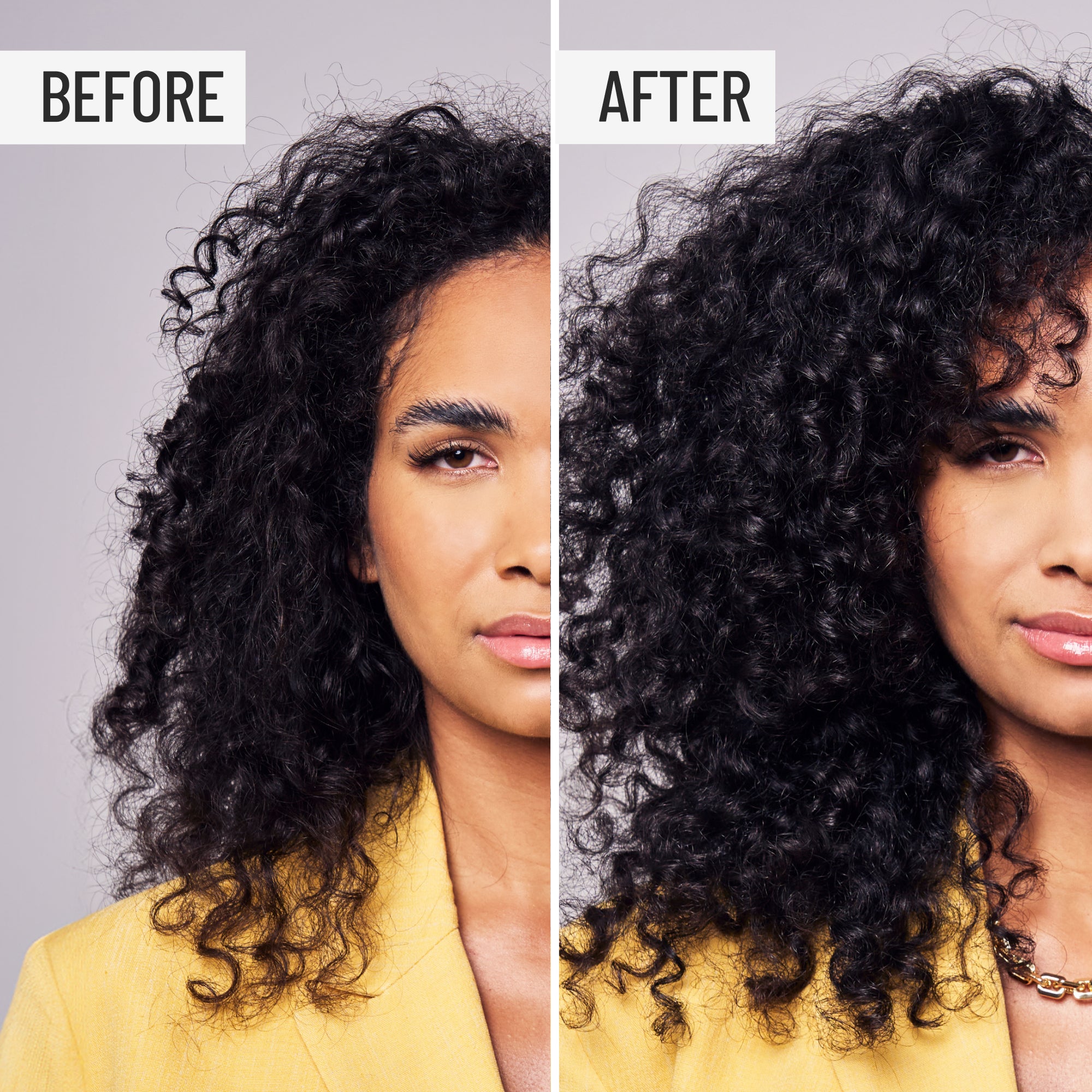
The experience of dryness in curly and coily hair is so consistent across individuals, climates, and product routines that it is often accepted as simply the nature of the hair type. It is not. It is a predictable consequence of structural geometry: the architecture of the follicle, the cross-sectional shape of the fiber, and the physics of how the scalp's natural oils travel along a curved surface. Understanding why the dryness occurs and where in the system it originates changes what can realistically be done about it.
The Source of the Problem: Follicle Geometry
Sebum, the lipid mixture that constitutes the hair's natural protective film, is produced by the sebaceous gland and secreted into the follicular canal. From there, it travels outward along the hair shaft, coating the fiber as it emerges from the scalp. In straight hair, the follicle exits the scalp at a near-perpendicular angle, and the fiber emerges on a relatively direct path. Sebum has a clear, mechanically favorable route to the surface and along the fiber.
In curly and coily hair, the follicle itself is curved — not just the emerging fiber, but the canal through which the fiber grows and sebum travels. The follicle exits the scalp at an acute angle rather than perpendicular, and its interior curvature means that sebum must navigate a bent passage before it even reaches the surface. This is not a distribution problem that begins at the scalp. It is an architectural problem that begins inside the follicle. Sebum production may be entirely normal — the follicle may be functioning exactly as it should — and yet the sebum cannot efficiently exit the follicular canal to coat the emerging fiber. The geometry is the obstruction.
The dryness that characterizes curly and coily hair does not begin at the ends. It begins in the follicle, before the fiber has even emerged. By the time the hair reaches the scalp surface, the sebum deficit is already structural.
The Distribution Problem: Geometry Along the Fiber
Even the sebum that does reach the scalp surface faces a second geometric obstacle: traveling the length of a curved fiber. On a straight fiber, sebum migrates from root to tip by capillary action, a passive process driven by surface tension and the continuous, unobstructed path the fiber provides. The fiber's circular or near-circular cross-section maximizes the efficiency of this migration. Sebum distributed at the root reaches the mid-shaft and, over time, the ends.
Curly hair has an increasingly elliptical cross-section; the tighter the curl, the more flattened the fiber's shape. This asymmetry matters for sebum distribution because capillary migration along an elliptical surface is less efficient than along a circular one. More significantly, each curve in the fiber path interrupts the continuous capillary channel along which sebum travels. Every bend is a point where sebum accumulation stalls — where the geometry of the fiber surface creates a local equilibrium so that sebum does not migrate past under normal conditions.
The consequence is a sebum gradient along the fiber length: the proximal section near the scalp receives some sebum coating, but the mid-shaft and ends are progressively depleted. In tightly coily hair, where the fiber may complete multiple full rotations before reaching a length of a few centimeters, the gradient is extreme. The ends of coily hair are, structurally, among the most sebum-depleted surfaces in the human body. Not because of insufficient production, but because the path the sebum would need to travel to reach them is geometrically impassable.
The Cross-Section and Its Consequences
The elliptical cross-section of curly and coily hair has consequences beyond sebum distribution. The asymmetric distribution of cortical cells within an elliptical fiber — with different proportions of ortho cortex (on the convex or "external side" of the curve) and paracortex cells on opposite sides of the shaft — creates differential mechanical stress within the fiber, contributing to its curl pattern. This same asymmetry means that the fiber's response to water absorption, humidity, and mechanical force is inherently uneven across its cross-section, producing the swelling behavior that causes curl patterns to expand with humidity and the mechanical vulnerability at the elliptical edges of the fiber, which makes coily hair more susceptible to breakage under tension.
The cuticle layer on an elliptical fiber also behaves differently from the cuticle on a circular one. On the curved outer edge of a coily fiber, cuticle scales are under tension and more prone to lifting. On the inner curve, they are compressed. Neither condition represents the optimal flat-lying state that protects the cortex and provides a smooth surface for fiber-to-fiber interaction. Even before any chemical processing or detergent washing has occurred, the cuticle of coily hair is structurally more exposed than that of straight hair. Not damaged — but in a less mechanically protected configuration.
How Detergent Compounding Makes a Structural Problem Worse
The sebum deficit in curly and coily hair, by structural necessity, is the baseline. Detergent shampoo operates on top of that baseline. As established in the physics of surface-active agents, every detergent crosses the sebum-stripping threshold — the binding energy holding the sebum film in place — with each wash. For straight hair, which can distribute sebum along most of its length between washes, the stripping is a disruption of an intact protective system. The system is compromised, but it was functional before the wash and will partially recover between washes as new sebum is produced and distributed.
For curly and coily hair, the sebum system was never fully intact along the fiber length to begin with. The detergent does not disrupt a complete protective system; it removes the partial one that geometry allows, leaving the fiber with less protection than it had before washing and less capacity to recover between washes. The proximal section, which did have a sebum coating, is stripped. The mid-shaft and ends that had little or none are left with nothing. The structural dryness that characterizes untreated coily hair becomes acute dryness after detergent washing, because the detergent has removed the only sebum the geometry managed to deliver.
Detergent shampoo is poorly suited to all hair types with respect to sebum preservation. It is specifically damaging to curly and coily hair because it removes a protective film that the structural geometry of the hair cannot adequately replenish between washes. The problem is not the washing. It is the mechanism.
Co-Washing: The Right Observation, the Wrong Solution
The natural hair community arrived at the same conclusion through collective observation that hairdressers reached in the professional context: conventional shampoo damages hair in proportion to its use, and reducing or eliminating it yields better outcomes. The response that became widespread — co-washing, or washing with conditioner only — reflects a correct understanding of the problem and an incomplete solution to it.
Conditioner does not clean. Its primary active agents — quaternary ammonium compounds, silicones, and film-forming polymers — are designed to adsorb onto the hair surface and modify its properties: reducing friction, neutralizing electrostatic charge, and temporarily smoothing lifted cuticle scales. They perform these functions effectively. None of them has a mechanism to remove surface residue, oxidized sebum, environmental deposits, or the accumulation of conditioner from previous washes.
Co-washing trades one problem for another. The stripping caused by detergent is avoided, which is a genuine improvement, and the reason co-washing produces better-feeling hair than detergent shampooing for many people with curly and coily textures. But the absence of stripping is not the same as cleaning. Residue accumulates on the scalp and along the fiber with each co-wash. Over time, this accumulation affects scalp health by clogging follicles, altering the scalp's microbial environment, and creating a buildup that eventually forces a return to detergent shampooing to clear it. The cycle resumes. The stripping damage returns. The improvement from co-washing is real but temporary, because the approach that produces it is not sustainable as a sole cleansing method.
Co-washing correctly identifies that the problem is the detergent. Its limitation is that removing the detergent from the routine, without replacing it with a non-detergent cleansing mechanism, leaves cleaning itself unaddressed. The hair feels better. It is not being cleaned.
What to Do
A cleaning system that operates below the sebum threshold removes surface residue without crossing the binding energy of the sebum film. For straight hair, this preserves a protective system that was largely intact between washes. For curly and coily hair, it preserves something more critical: the partial sebum coating that the follicle geometry managed to deliver, which represents essentially all the natural protection the fiber length can receive. The baseline condition of the hair — structurally dry at the distal end due to geometry — is not worsened by the cleaning agent. The hair arrives at the next wash in the best condition the geometry permits.
Curly and coily hair is not inherently damaged hair. It is hair whose structural geometry creates a set of challenges that conventional hair care was never designed to address, and that detergent shampoo consistently makes worse. The question worth asking of any cleansing product is not which conditioning agents it contains, but whether its primary cleaning mechanism crosses the sebum threshold. If it foams, it does. And for hair that structurally cannot replenish what stripping removes, that is the question that matters most.
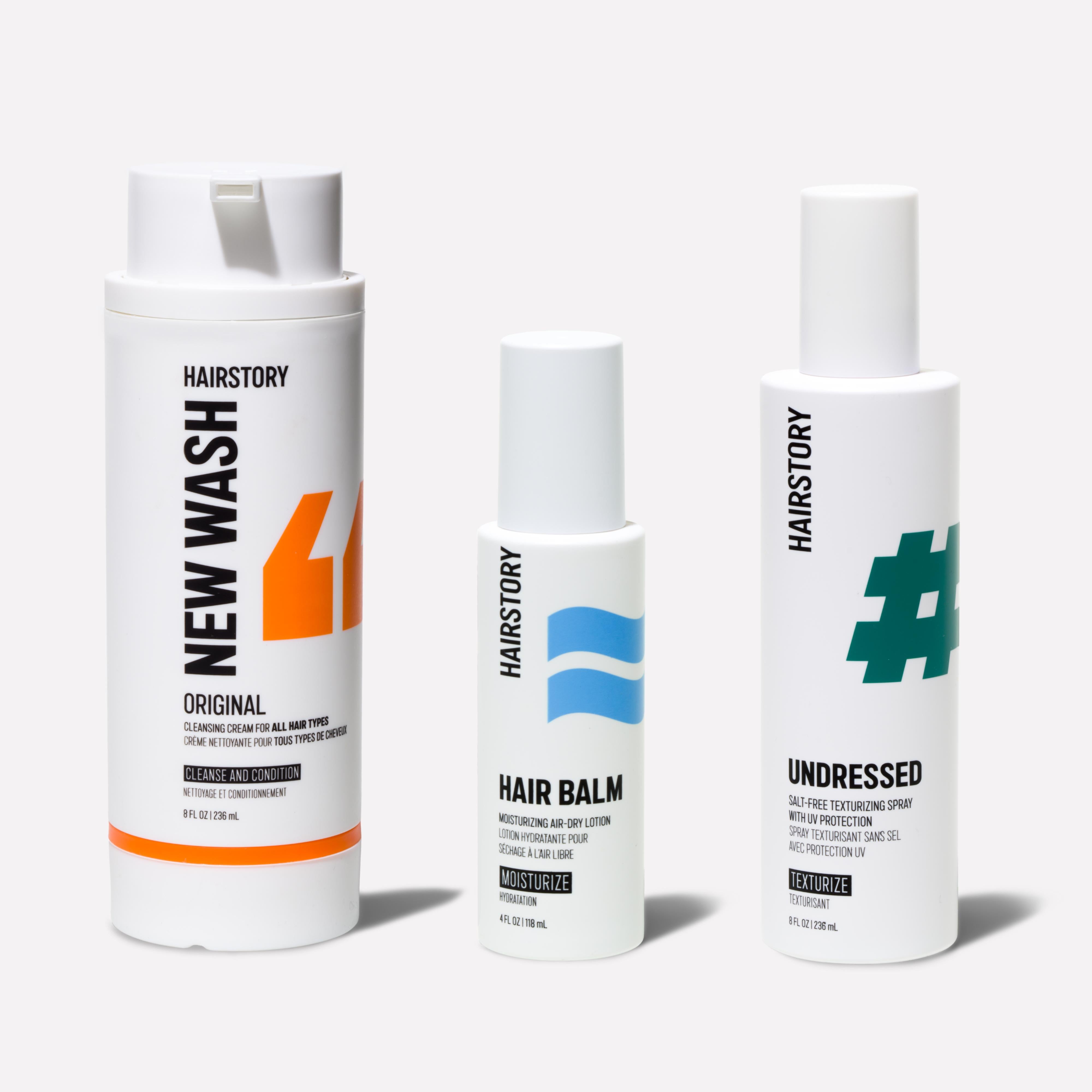
New Wash Rich was formulated specifically with curly and coily hair in mind — a detergent-free cleansing cream that cleans below the sebum threshold, so the natural protection geometry managed to deliver stays intact.
Next in this series: Article 9 — Why Am I Losing My Hair in My 20s? The biology of early hair loss. What drives it, why it differs between men and women, what the evidence supports, and where the window for intervention actually is.
About the Author
Mauricio Gatto Bellora holds a doctorate in Pharmaceutical and Biochemical Sciences from the University of Buenos Aires, with a research specialization in microencapsulation. He has served as CEO of multiple global companies across the pharmaceutical, cosmetics, and nutrition sectors, including Allergan Latin America, Natura Cosmeticos, and MonaVie. He is a co-founder of Hairstory. Read more from Mauricio.
Read More
- WTF Are Detergents and Surfactants?
- The Strip-and-Restore Trap: How Shampoo Created the Products That Followed It
- The Surfactant Spectrum: Why No Detergent Is Mild Enough
The information in this article is for educational purposes only and is not intended as medical advice. Always consult a board-certified dermatologist or qualified healthcare provider if you have concerns about your hair or scalp health.