Frizz is not a hair type. It is a condition — one with a precise cause, a visible mechanism, and a solution that has nothing to do with the products currently marketed to treat it.
By Mauricio Gatto Bellora, Dr. in Pharmaceutical and Biochemical Sciences | Co-founder, Hairstory
Frizz is one of the most common complaints in hair care and one of the most consistently misunderstood. The products marketed for it — anti-frizz serums, smoothing creams, humidity-resistant sprays — treat it as though it were a permanent characteristic of certain hair types, something to be managed indefinitely with the right combination of products. It is not. Frizz is a condition produced by a specific mechanism, and understanding that mechanism changes everything about how you respond to it.
What Frizz Actually Is
Each hair fiber is surrounded by a cuticle: a layer of overlapping protein scales that lie flat when the fiber is healthy, creating a smooth surface that reflects light evenly and allows adjacent fibers to slide past each other without resistance. When the cuticle scales are lying flat, and the fiber's surface is intact, the hair behaves as a coherent unit. Individual fibers move together, light reflects uniformly, and what we perceive as smooth, defined hair is the result.
Frizz is what happens when the cuticle scales lift. Lifted scales on individual fibers catch on the lifted scales of neighboring fibers, disrupting the coherent movement of the hair mass. Each fiber starts behaving independently rather than as part of a group. The surface becomes irregular, light scatters rather than reflects, and the hair expands outward rather than falling in a defined shape. This is frizz: not a property of the hair, but a property of the cuticle surface.
Humidity does not cause frizz. It reveals it. Hair with intact cuticle scales and an intact sebum film is remarkably resistant to humidity. Hair with lifted scales and a stripped surface absorbs atmospheric moisture unevenly, swells asymmetrically, and produces exactly the expanded, undefined appearance that the anti-frizz category exists to temporarily suppress.
What Lifts the Scales — And the Physics You Can See
The cuticle scales are held flat by the sebum film — the natural lipid layer the scalp produces and distributes along the hair shaft. Sebum fills the microscopic gaps between scales, acts as a lubricant between adjacent fibers, and maintains the surface chemistry that keeps the cuticle in its flat, protective configuration. When the sebum film is intact, the cuticle behaves as it is designed to. When it is removed, the scales lift.
As established in The Surfactant Spectrum, every detergent shampoo — regardless of its marketing positioning, its sulfate-free claim, or its price point — crosses the sebum-stripping threshold with each wash. The foam produced during washing is the visible confirmation that this is happening. A foaming product generates the same surface-tension force that displaces sebum from the hair. The two effects share one cause.
Once the sebum is stripped, the cuticle scales lift. But something else happens simultaneously — something whose effects are immediately visible even if its cause is not: the hair acquires an electrostatic charge.
Here is the physics, stated plainly. Every object carries an electrical charge. When surfaces separate — as hair fibers do constantly during washing, towel drying, and movement — electrons can transfer from one surface to another. The intact sebum film acts as a natural conductor, allowing charge to distribute evenly and dissipate. When sebum is stripped, and the fiber's protein surface is exposed, the hair loses its conducting layer. Charge builds up and stays. Specifically, hair protein at the pH of normal washing conditions acquires a net negative charge.
Like charges repel. Every fiber in the head is now negatively charged, which means each fiber is pushing away from the others. Instead of falling together in coherent groups, they splay outward. Flyaways stand away from the head because they are literally being repelled by the hair beneath them. The hair that seemed manageable before washing becomes impossible to control after — not because water changed it, but because the washing removed the sebum that was keeping the charge balanced. This electrostatic repulsion compounds the mechanical interlocking of lifted cuticle scales: scales catch on each other, charge pushes fibers apart, and the result is the expanded, undefined, resistant-to-everything state that most people simply call frizzy hair.
The hair is now in the exact structural condition that produces frizz. It will stay in that condition until the sebum film is restored — which, in the context of a conventional washing routine, happens partially between washes as the scalp produces new sebum, only to be stripped again at the next wash.
Why Humidity Is a Trigger, Not a Cause
The relationship between frizz and humidity is real but frequently misunderstood. Humid air does not create frizz in hair with an intact cuticle and a healthy sebum film. What it does is expose the vulnerability of hair that has already been structurally compromised.
When cuticle scales are lifted and the sebum film is absent, the cortex — the interior of the hair fiber — is partially exposed to the environment. Keratin protein absorbs water. In high humidity, the cortex absorbs atmospheric moisture through the gaps left by lifted scales, swells unevenly, and produces the expansion and loss of definition characteristic of humid-day frizz. The same hair in low humidity may look controlled — not because the structural problem has resolved, but because the trigger is absent.
This is why anti-frizz products that work in dry conditions often fail in humidity. They are coating a compromised surface, not repairing it. When atmospheric moisture penetrates the coating and reaches the damaged cuticle beneath, the underlying structural problem asserts itself regardless of what was applied on top.
What the Anti-Frizz Category Actually Does
Anti-frizz serums, smoothing treatments, and humidity-resistant sprays work by depositing on the surface — they coat the cuticle with silicones, polymers, or film-forming agents that temporarily smooth lifted scales and reduce the fiber's exposure to atmospheric moisture. The effect is real and often impressive in the short term. The mechanism is cosmetic. It is a typical "Ostrich Strategy": you don't see the root cause of the problem expressing itself, so it does not exist.
The coating does not lower the cuticle scales. It covers them. The sebum film is not restored. The structural condition that produces frizz persists beneath the coating — and the coating itself requires periodic removal, typically with a stronger detergent, which strips away whatever sebum has accumulated since the last wash and resets the damage cycle. The consumer who buys an anti-frizz product to manage the frizz caused by their shampoo is purchasing a corrective response to a problem the shampoo creates. This is the strip-and-restore dynamic described in The Strip-and-Restore Trap, applied specifically to the frizz experience.
The frizz product does not solve frizz. It manages the interval between each recurrence of the conditions that cause it. As long as the cleaning mechanism continues to strip the sebum film, the cuticle scales continue to lift, the charge continues to build, and the structural basis for frizz is renewed with every wash.
What the Right Approach Looks Like
The structural basis for frizz — lifted cuticle scales, absent sebum film, net negative charge on the fiber surface — is not inevitable. It is produced by a specific cleaning mechanism, and it can be avoided by changing that mechanism.
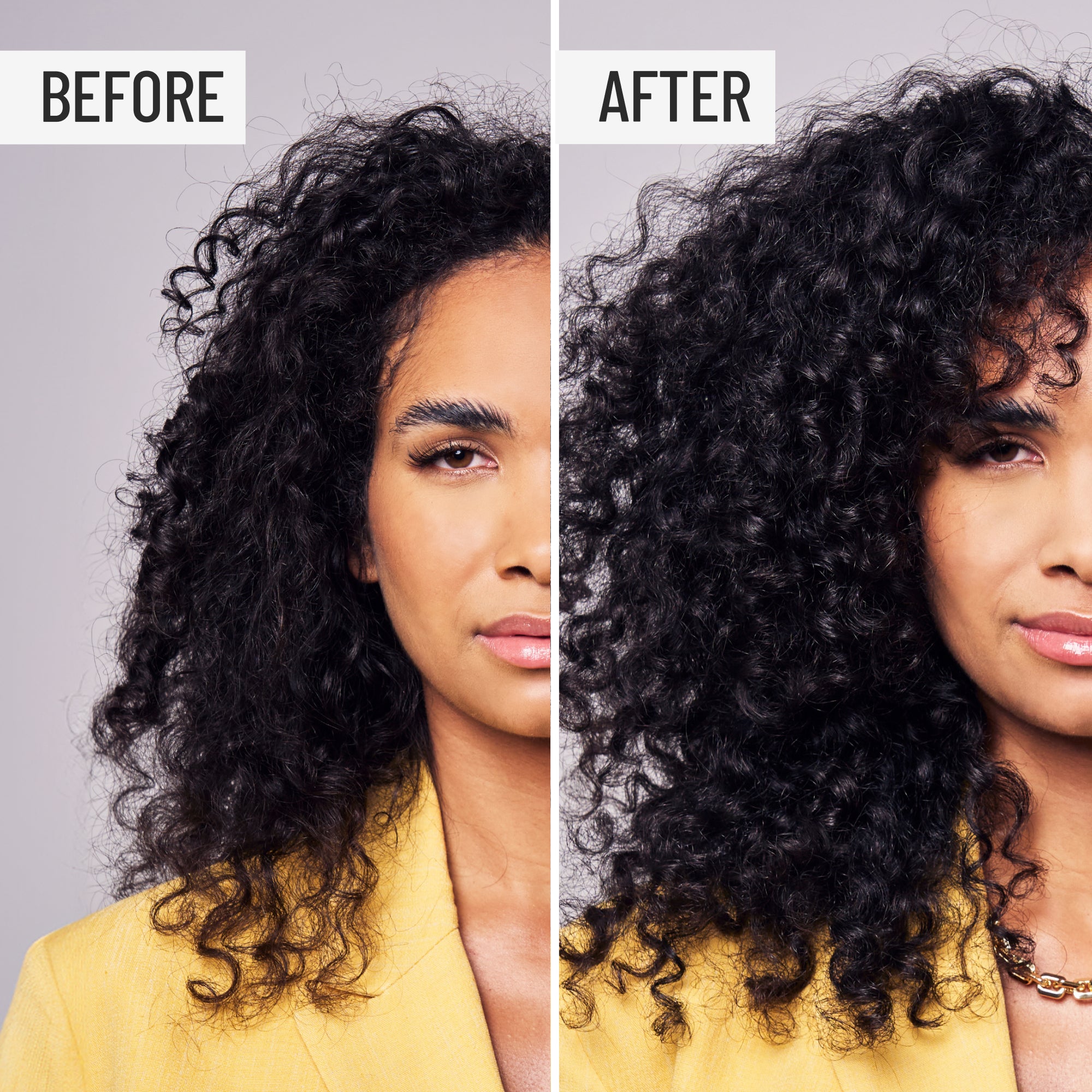
A cleaning system that operates below the sebum-stripping threshold removes surface residue without displacing the sebum film. When the sebum film remains intact after washing, the cuticle scales stay flat, the charge remains balanced, and the fiber surface behaves as designed. Fibers move together. Flyaways lie down. Humidity finds no exposed cortex to penetrate. The structural conditions that produce frizz are simply not created.
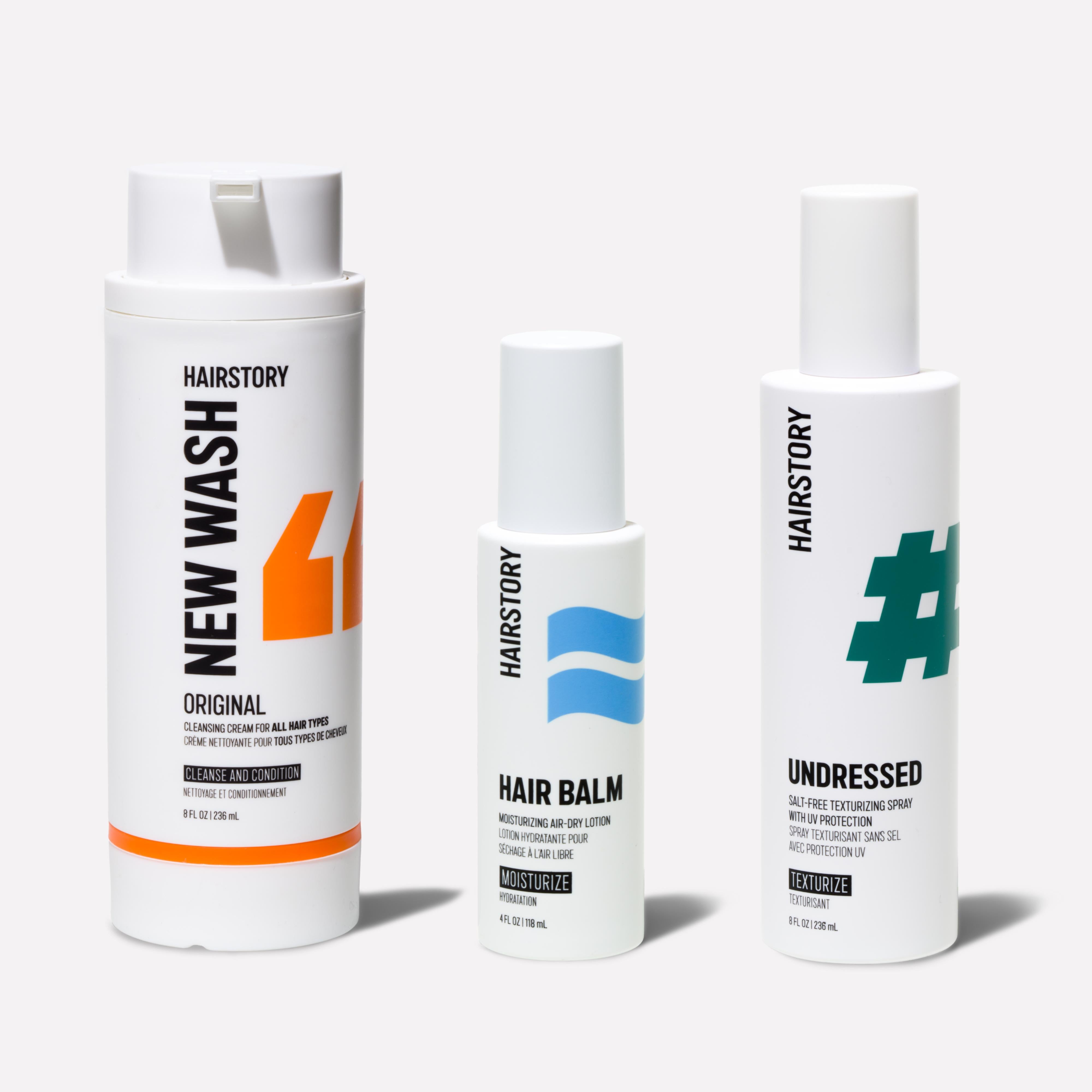
The practical signal that a cleansing product is operating below this threshold is the absence of foam. As established in The Surfactant Spectrum, foam is the visible confirmation that a molecule generates sufficient surface-tension force to trap air at the water surface with little thermodynamic effort — the same force that strips sebum. A cleansing product that does not foam is operating below the threshold. The sebum film it leaves intact is the foundation on which everything else — curl definition, frizz resistance, humidity tolerance — depends. New Wash is built on exactly this principle: it cleanses without crossing the sebum-stripping threshold, which means the cuticle stays flat, the charge stays balanced, and frizz loses its structural basis.
The adjustment period some people — mainly those with oily or very oily hair — experience when switching from a detergent-based to a non-detergent cleansing system reflects the time required for the sebum system to recalibrate after repeated stripping. During this period, the hair may feel unfamiliar. What is actually happening is the cuticle scales beginning to lie flat on a surface that is no longer being repeatedly disrupted — and the electrostatic charge that drove the flyaways and the splay beginning to dissipate as the sebum film returns.
Frizz is a condition produced by a mechanism. Addressing the mechanism is the only intervention that resolves the condition rather than managing its symptoms. Everything else is a coating over a problem that the next wash will renew.
About the Author
Mauricio Gatto Bellora holds a doctorate in Pharmaceutical and Biochemical Sciences from the University of Buenos Aires, with a research specialization in microencapsulation. He has served as CEO of multiple global companies across the pharmaceutical, cosmetics, and nutrition sectors, including Allergan Latin America, Natura Cosméticos, and MonaVie. He is a co-founder of Hairstory. Read more from Mauricio.
Next in this series: Article 12 — Why Is My Hair Getting Thinner After 50 and What Can I Actually Do About It? The biology of female hair thinning, what accelerates it, what the evidence supports, and the honest boundary between what can be influenced and what cannot.
Referenced in This Article
- The Surfactant Spectrum — Mauricio Gatto Bellora on Substack
- The Strip-and-Restore Trap — Mauricio Gatto Bellora on Substack
Keep Reading
- The Surfactant Spectrum: Why No Detergent Is Mild Enough
- The Strip-and-Restore Trap: How Shampoo Created the Products That Followed It
- Why Does My Hair Tangle So Badly?
- Why Is Curly and Coily Hair Always Dry?
The information in this article is for educational purposes only and is not intended as medical advice. Always consult a board-certified dermatologist or qualified healthcare provider if you have concerns about your hair or scalp health.